How to manage an increase in visual production without saturating your marketing teams?

Contents
When working in a marketing, product or communication team, there are times when everything is packed. Launching a product, media campaign, fundraising, or simply a new, more ambitious pace of publication.
Result: Visual creation needs explode... and the team is not always ready to follow.
Whether it's a hot spot or a strategic turning point for your company, here's how to structure your visual production without losing quality or efficiency.
Identify whether the increase in visual production is temporary or sustainable
Expedient analysis of the situation
Before heading head down in production, take a moment to understand why demand is exploding.
What's the trigger?
Try to point out the precise origin of this increase:
- A specific marketing campaign
- A product launch
- A seasonal commercial operation (Black Friday, sales, return...)
- A strategic change (new positioning, internationalisation...)
Understanding the context allows for a better dimension of the response.
Is it punctual or recurring?
If you are facing a punctual peak (emergency campaign, exceptional event, response to a call for tenders), you will probably have to react quickly, even if you are outsourcing or allocating emergency resources.
If, on the other hand, this type of demand is likely to repeat itself (new acquisition strategy, more sustained social media rhythm, launch of a new BU), you have to think scalable and structured.
Are there any signs of intensification?
The growth of your business is accelerating? Are you planning a surge in the pay media? Your roadmap produces fabric?
All these elements are signals that the need for graphic creation will not come down quickly.
In summary: Identify whether it is a straw fire or a new standard will prevent you from making bad decisions in an emergency.
Assess your current visual production capacity
How many visuals do you produce today?
Make a clear estimate: how many visuals your team produces every week?
Then compare with future needs: how many will it take in the coming weeks or months?
This gap immediately gives an idea of the capacity to fill.
Who produces the visuals today?
Are these:
- designers in-house
- Freelance
- an agency
Are they specialized (motion design, social media, print...) or generalist?
Do they work under effective conditions or spend 50% of their time managing incomplete validations and briefings?
Identify friction points
Very often, it is not the talents that are lacking, but the processes.
- Briefs
- Inadequate tools
- Lack of prioritization
- Too long validation circuits
A simple optimization of these points can already free up a lot of capacity.
Prioritize content according to marketing objectives
When the volume of graphic creation increases, it becomes impossible to produce everything immediately. Prioritization becomes essential.
Linking each visual to a business goal
Each visual content must serve a clear purpose:
- Acquisition
- Awareness
- Commitment
- Brand image
Acquisition: aiming for performance
- Advertising formats (Ads, Google Display, YouTube Pre-Roll)
- Visuals of landing pages
- Email marketing optimized conversion
Here, the design follows performance and data.
Awareness: developing visibility
- Social media regular posts
- Videos branding
- Field visuals
Commitment: creating interaction
- Surveys
- UGC
- Interactive content
Love Brand: Building the Image
- Visual Storytelling
- Emotional formats
- Brand contents
Identify content at ROI rapid
When visual production increases, it is strategic to identify the most efficient formats.
Reusable social media templates
Templates quickly produce consistent content.
Ads with creative variations
Paid campaigns require many visual variations.
Formats with strong reach
- Carrousels LinkedIn
- Reels / TikTok
- Data-driven infographics
Explore the different graphical production options
Production in-house without designer
Marketing teams can produce some simple content with adapted tools:
- Canva
- Figma
- Concept or Trello
- Tools IA
This offers a strong reactivity but has limitations in graphical consistency.
Outsourcing visual production
Outsourcing allows for a rapid increase in production capacity.
Agency
Suitable for strategy and creative concepts.
Freelance
Flexible but dependent on one person.
Graphic Studio
The most suitable model for high volume visual production.
A graphic studio allows you to quickly produce:
- Ads
- social media visuals
- Presentations
- infographics
Recruit a designer internally
If the need becomes structural, recruiting may be relevant.
Benefits
- better integration into business culture
- responsiveness
- marketing autonomy
Limits
- recruitment time
- wage cost
- sometimes specialized profile
Update graphic foundations
Before increasing visual production, make sure the graphic bases are solid.
Create a centralized brand kit
- logos
- colours
- typography
- templates
Set Rules by Channel
- social media
- ads
- video
Build a visual production roadmap
Estimate time by format
- social visual: 24 to 48h
- LinkedIn carousel: 2-3 days
- motion ads: 3 to 5 days
Planning production
- Week 1: Emergency
- Week 2–3: Planned content
- Week 4–6: anticipation
Integrate validation cycles
Provide 1 to 2 return loops to avoid delays.
Structure creative briefs
A good brief speeds up all production.
- Objective
- Target
- Key message
- Channel
- Format
- Deadline
Strengthening operational pilotage
Visual production requires clear control.
The role of the design project manager
- prioritise applications
- clarify the briefs
- follow deadlines
- ensuring graphic consistency
This is the role of Feazer project leaders.
Conclusion: Structure visual production before producing
When the demand for graphic creation increases, the worst reflex is to produce in emergency without organization.
The right reflex is:
- analyse
- prioritize
- structure
- then produce
With a good tool stack, solid templates and clear control, it becomes possible to increase visual production without saturating marketing teams.
And if you need a structured reinforcement to absorb the load, a graphic studio like Feazer can accompany your teams in the long term.
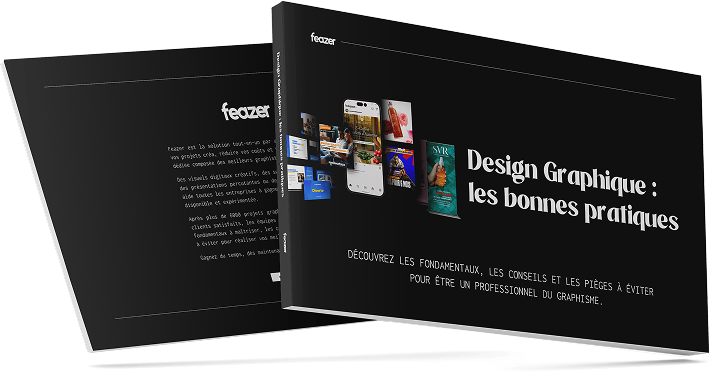
Our exclusive Ebook:Good practices in Graphic Design
Discover the fundamentals, tips and pitfalls to avoid in order to be a graphic professional.